
Domicile Certificate
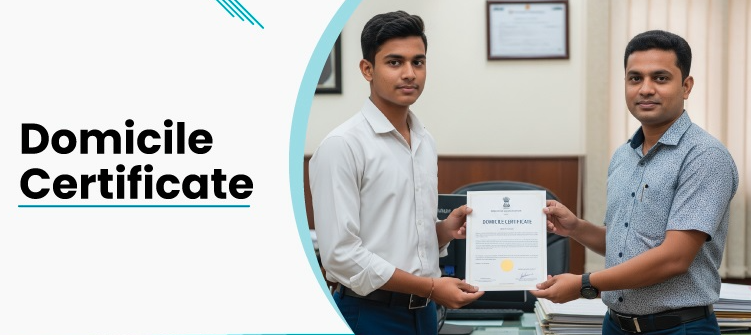
1. What is a Domicile Certificate?
A Domicile Certificate is an official document issued by the state government to certify that a person is a resident of a particular state. It is often required for applying to government jobs, scholarships, or admission under the state quota in educational institutions.
2. Eligibility Criteria
The applicant must be a resident of the state for a certain period (usually 5 years or more, depending on the state).
Both Indian citizens and children of residents (if born in the state) can apply.
Individuals who moved to the state for work or studies may also apply, subject to state rules.
3. Documents Required
Typically, the following documents are required (may vary slightly by state):
Proof of Residence:
Aadhaar Card
Voter ID
Ration Card
Utility Bills (Electricity/Water/Gas)
Rental Agreement (if applicable)
Identity Proof:
Aadhaar Card
PAN Card
Passport
Affidavit / Declaration stating the applicant has been residing in the state for the required period.
Birth Certificate (if needed to prove state residence by birth).
How to Apply
Online:
Many states have official portals for Domicile Certificate application.
Fill the application form, upload scanned copies of the required documents, and pay any applicable fee.
Track status online and download the certificate once approved.
Offline:
Visit the Tehsil / Sub-Divisional Magistrate office or District Collectorate.
Fill the application form and submit the required documents.
After verification, the certificate will be issued within the stipulated time.
5. Fees
Usually nominal, ranging from ₹50 to ₹200 depending on the state.
Some states may allow online payment.
6. Validity
Generally, the Domicile Certificate does not expire, but some institutions may require a recent certificate.
Keep it updated if any personal details change.
7. Uses of Domicile Certificate
Applying for state government jobs.
Admission under state quota in educational institutions.
Claiming state-specific scholarships or benefits.
For property registration or other legal purposes in the state.
A Domicile Certificate is a key legal document that proves your permanent residency in a state, enabling access to government schemes, educational advantages, and employment opportunities. Always ensure that your documents are complete and accurate to avoid delays.
Domicile Certificate: Procedure for Update & Correction _________________________________________________________________________________

1. When is Update or Correction Needed?
You may need to update or correct a Domicile Certificate in cases like:
Change in Name (due to spelling mistake or official name change)
Correction in Date of Birth
Address Change (if you have moved within the same state)
Correction in Parents’ Name
Typographical errors in the certificate
2. Documents Required for Update / Correction
The documents will depend on what you want to correct:
For Name / DOB / Parents’ Name:
Original Domicile Certificate
Proof of correct Name / DOB / Parents’ Name (Aadhaar, Birth Certificate, Passport)
Affidavit stating the correct details
For Address Change:
Original Domicile Certificate
Proof of new address (Aadhaar, Voter ID, Utility Bills, Rental Agreement)
Affidavit declaring the change in residence
For General Correction (Typo / Minor Errors):
Original Domicile Certificate
Supporting document proving correct detail (as applicable)
How to Apply for Update / Correction
Online:
Visit the official state portal for Domicile Certificate.
Select Update / Correction option.
Upload the scanned original certificate and supporting documents.
Fill in the correct details.
Submit the application and pay the applicable nominal fee.
Track the status online. The corrected certificate can usually be downloaded online once approved.
Offline:
Visit the Tehsil / Sub-Divisional Magistrate / District Collector office.
Submit original certificate, correct documents, and application for correction.
After verification, the corrected certificate will be issued.
4. Fees
Usually nominal, ₹50–₹200 depending on the state.
Online payment may be accepted in some states.
Ensure all supporting documents are attached for corrections, as minor errors are promptly updated, and retain copies of both the old and revised certificates for future reference.